

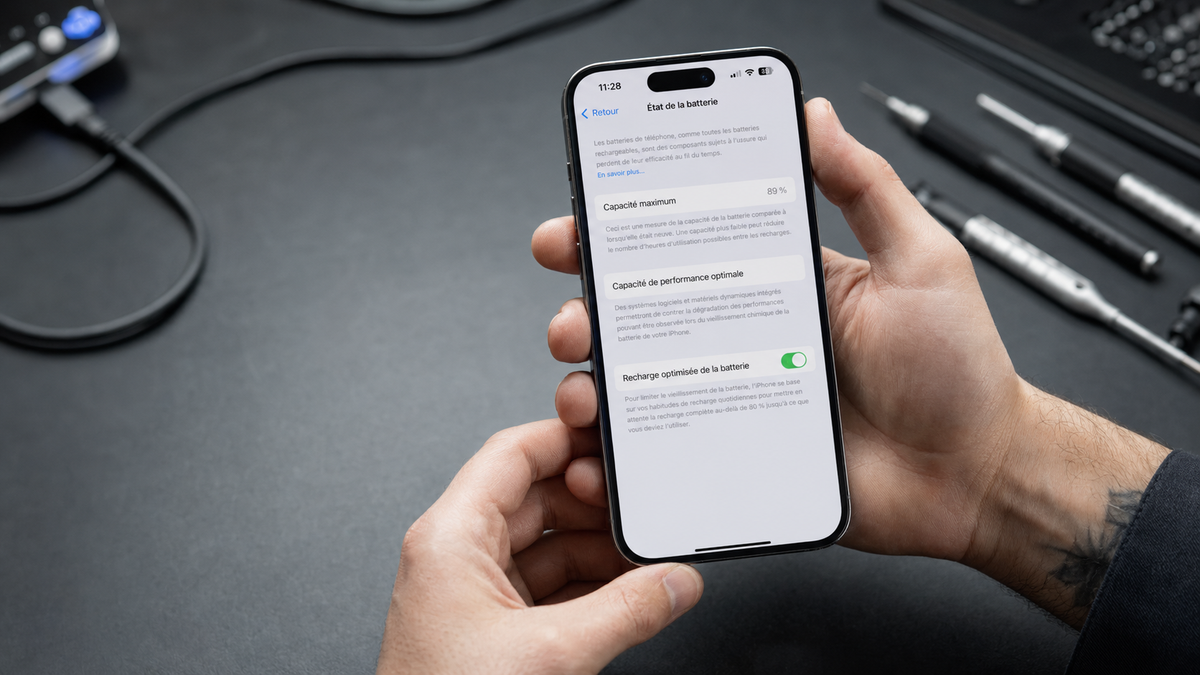
Refurbished iPhone Battery: Is 80%, 85%, or a New Battery Best?
The battery is often the first concern when shopping for a refurbished iPhone. Is 80% battery health enough? Does 85% guarantee good battery life? Is an iPhone showing 100% always the better choice?
The answer is more nuanced than a single percentage. Battery health matters, but so do the iPhone model, the way you use it, the quality of any replacement battery, and how thoroughly the device was tested before being sold.
Here is how to understand the numbers and avoid a deal that only looks good on paper.
Quick answer: What battery health should you choose?
| Battery health shown | What it generally means | Best suited for |
|---|---|---|
| 100% | A new or barely used battery. The quality and history of the part should still be verified. | Heavy use, long days, and maximum peace of mind. |
| 90% to 99% | Very good remaining capacity. | An excellent choice for most users. |
| 85% to 89% | Still reasonable if the iPhone works normally and has been properly tested. | Moderate daily use and good value. |
| 80% to 84% | A more heavily worn battery. Battery life may be limited depending on the model and how it is used. | Worth considering only if the price and purchase conditions are genuinely attractive. |
| Below 80% | The battery is generally approaching the point where replacement is recommended. | Best avoided for a ready-to-use refurbished purchase unless replacement is already planned. |
A higher number is reassuring, but it does not replace a complete diagnostic. A battery can display a good percentage and still drain quickly, overheat, or behave inconsistently.
What does the Battery Health percentage actually mean?
On an iPhone, maximum capacity compares the battery's current capacity with the capacity it had when it was new.
A maximum capacity of 85% does not mean the phone will stop charging at 85%. It means the battery can store approximately 85% of the energy it could hold when new.
As maximum capacity decreases, you may notice:
- less time between charges;
- a faster drop in percentage during demanding activities;
- the need to recharge before the end of the day;
- in some cases, reduced peak performance to help prevent an unexpected shutdown.
Apple states that batteries in iPhone 14 models and earlier are designed to retain 80% of their original capacity after 500 complete charge cycles under ideal conditions. Batteries in iPhone 15 models are designed to retain 80% after 1,000 complete charge cycles under ideal conditions. Actual results still depend on how the device is used and charged. You can read Apple's official explanation of iPhone battery and performance.
Is 80% battery health enough for a refurbished iPhone?
An iPhone can still function properly at 80% battery health. However, that does not necessarily mean it will provide the battery life most buyers expect from a refurbished device that is ready for everyday use.
The experience depends heavily on the model and your habits. A Pro Max model with 80% battery health may still be acceptable for lighter use because it started with a larger battery. The same percentage on a compact iPhone—or on a device used heavily throughout the day—may feel much more limiting.
If you regularly use the camera, GPS navigation, video calls, gaming, mobile hotspot, or social media, a battery already close to 80% may require an earlier recharge.
That is why price should not be the only consideration. A cheaper iPhone that soon needs a battery replacement may ultimately cost more than a slightly more expensive device that has been better prepared.
Is 85% battery health good?
Battery health of 85% is often considered a reasonable threshold in the refurbished-phone market. It can provide a satisfying experience if:
- the battery discharges consistently;
- the iPhone does not shut down unexpectedly;
- it does not overheat abnormally;
- charging works correctly;
- the device was tested under load, not simply turned on for a few minutes;
- the price fairly reflects the battery's remaining wear.
However, 85% should not be treated as a universal guarantee. Two batteries showing the same percentage can perform differently because of their age, quality, number of charge cycles, exposure to heat, and the previous owner's charging habits.
The percentage is a useful indicator—not a complete diagnosis.
Is a battery showing 100% always better?
Not necessarily.
A battery showing 100% can be an excellent choice if it is new, high quality, and properly installed. But the number alone does not reveal the quality of the part or the installation.
Before paying more for a “new battery” option, check:
- whether the seller identifies the type of battery installed;
- whether the battery and charging system were tested;
- whether the iPhone displays a message about an unknown part;
- whether the battery is covered against abnormal defects;
- whether Face ID, the display, cameras, network connectivity, and other functions were also inspected.
On supported models, you can review Parts and Service History under Settings > General > About. Apple explains that a part may appear as Unknown if it is not genuine, was previously used in another iPhone, was not installed completely, or is not functioning as expected. For more details, read Apple's guide to buying a preowned iPhone.
A 100% reading does not erase the other quality factors that matter.
The iPhone model matters as much as the percentage
Two iPhones at 85% maximum capacity will not necessarily deliver the same battery life.
Plus and Pro Max models generally have larger batteries than compact models. A newer iPhone may also benefit from a more efficient processor and improved power management.
Before choosing, ask yourself:
- Do I often spend long periods away from a charger?
- Do I frequently use GPS, video, games, or mobile hotspot?
- Do I prefer a compact phone or longer battery life?
- Do I plan to keep the device for several years?
For heavy or professional use, choose a higher remaining capacity or a high-quality new battery. For calls, messages, browsing, and social media, a properly tested battery may be enough even if it does not show 100%.
Five checks to make before buying
1. Ask how the battery is tested
A reputable seller should not rely on the displayed percentage alone. Charging, stability, temperature, power consumption, and the device's general behaviour should also be checked.
2. Read the warranty carefully
A battery is a consumable component that naturally wears over time. It is important to distinguish normal wear from an abnormal defect. Check what is covered, for how long, and under which conditions.
Phonio provides a 12-month commercial warranty on eligible defects, in addition to protections provided by law. Capacity loss caused by normal battery wear remains a consumable-related issue and is assessed according to the warranty terms.
3. Check the parts history
Under Settings > General > About, look for the Parts and Service History section when it is available. A message does not automatically mean the iPhone is unusable, but the seller should be able to explain it clearly.
4. Do not overlook the other functions
A good battery does not compensate for a problem with the display, cameras, Face ID, microphone, network connection, or charging port. A refurbished iPhone should be tested as a complete device.
5. Buy from an identifiable seller
A private listing may look less expensive, but it rarely includes the same level of testing, documentation, return protection, and after-sales support.
Before ordering, verify the company's identity, customer reviews, written policies, and support information. You can also read our complete guide to choosing a refurbished iPhone in Canada.
How Phonio checks the battery in a refurbished iPhone
At Phonio, the battery is included in the quality-control process completed before a device is sold. It is tested alongside the iPhone's other essential functions and replaced if it does not meet our established operating standards.
Our goal is not simply to display an attractive number. It is to prepare a reliable, unlocked iPhone that is ready to use and covered by a 12-month warranty and a 30-day return period, subject to the applicable terms.
Explore the refurbished iPhones available from Phonio and choose the model that fits your budget and the way you use your phone.
Conclusion
When evaluating the battery in a refurbished iPhone, do not focus only on whether it shows 80%, 85%, or 100%.
A good purchase depends on five elements: the displayed maximum capacity, the battery's real-world behaviour, the iPhone model, the quality of the testing, and the protection offered by the seller.
A properly tested battery in a fully inspected device is often worth more than an impressive number with no explanation. That transparency is what turns a used iPhone into a refurbished purchase you can feel confident about.
Ready to choose? Shop Phonio refurbished iPhones, tested, unlocked, and covered by a 12-month warranty.


